«The Silk Road»
public art installation
Monumental Fountain and Interactive Art Installation Inspired by Uzbekistan’s Heritage
The Silk Road is a monumental fountain and interactive art installation created as a contemporary tribute to Uzbekistan — a country whose history is deeply intertwined with the legacy of the Great Silk Road.
For centuries, the lands of present-day Uzbekistan stood at the crossroads of one of history’s most influential trade networks. Caravans traveled through these territories, connecting distant regions while facilitating the exchange of goods, knowledge, craftsmanship, architecture, music, and ideas. Cities such as Samarkand, Bukhara, Khiva, and Tashkent became far more than stops along a trade route; they evolved into cultural gateways linking East and West.
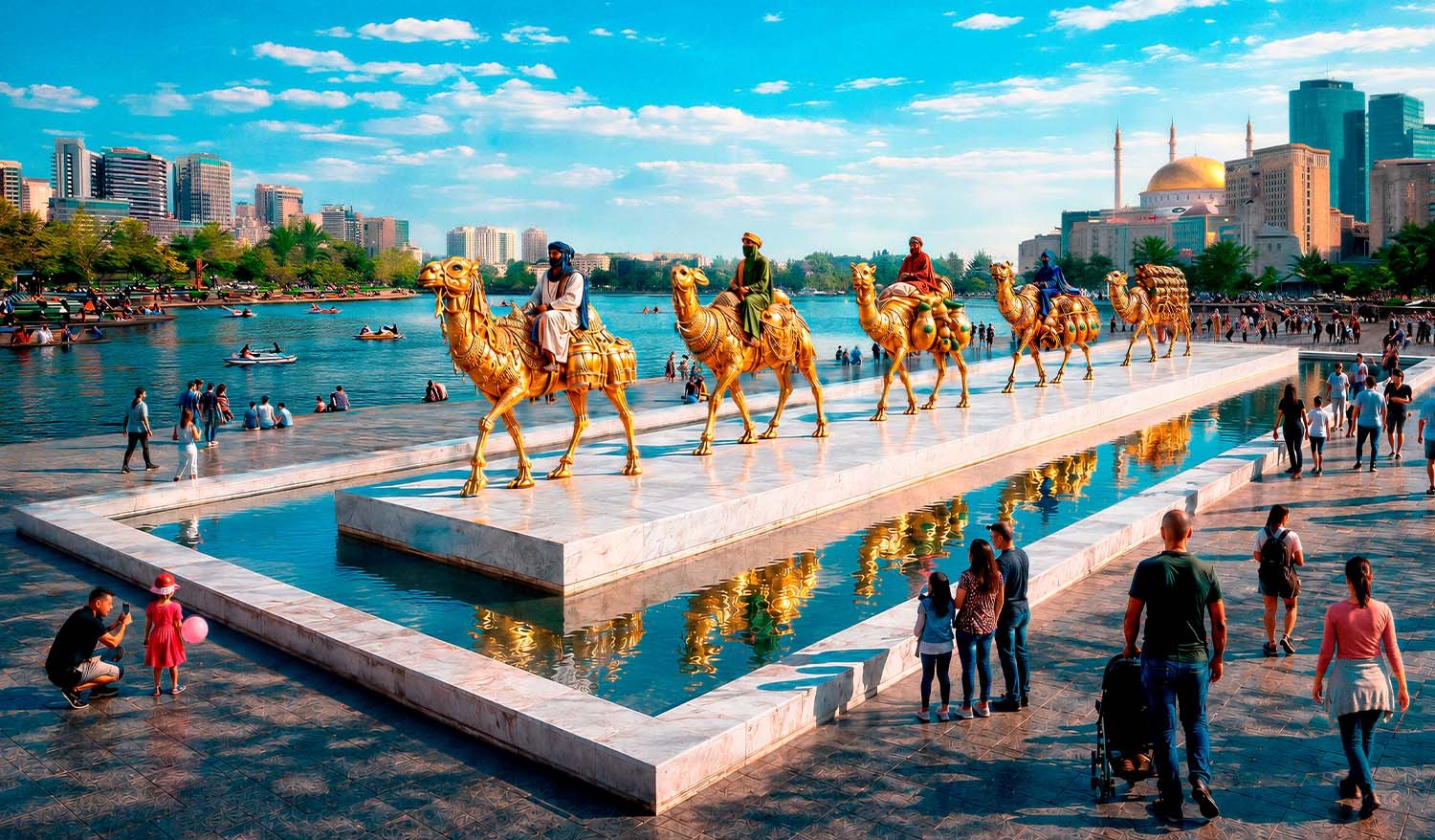
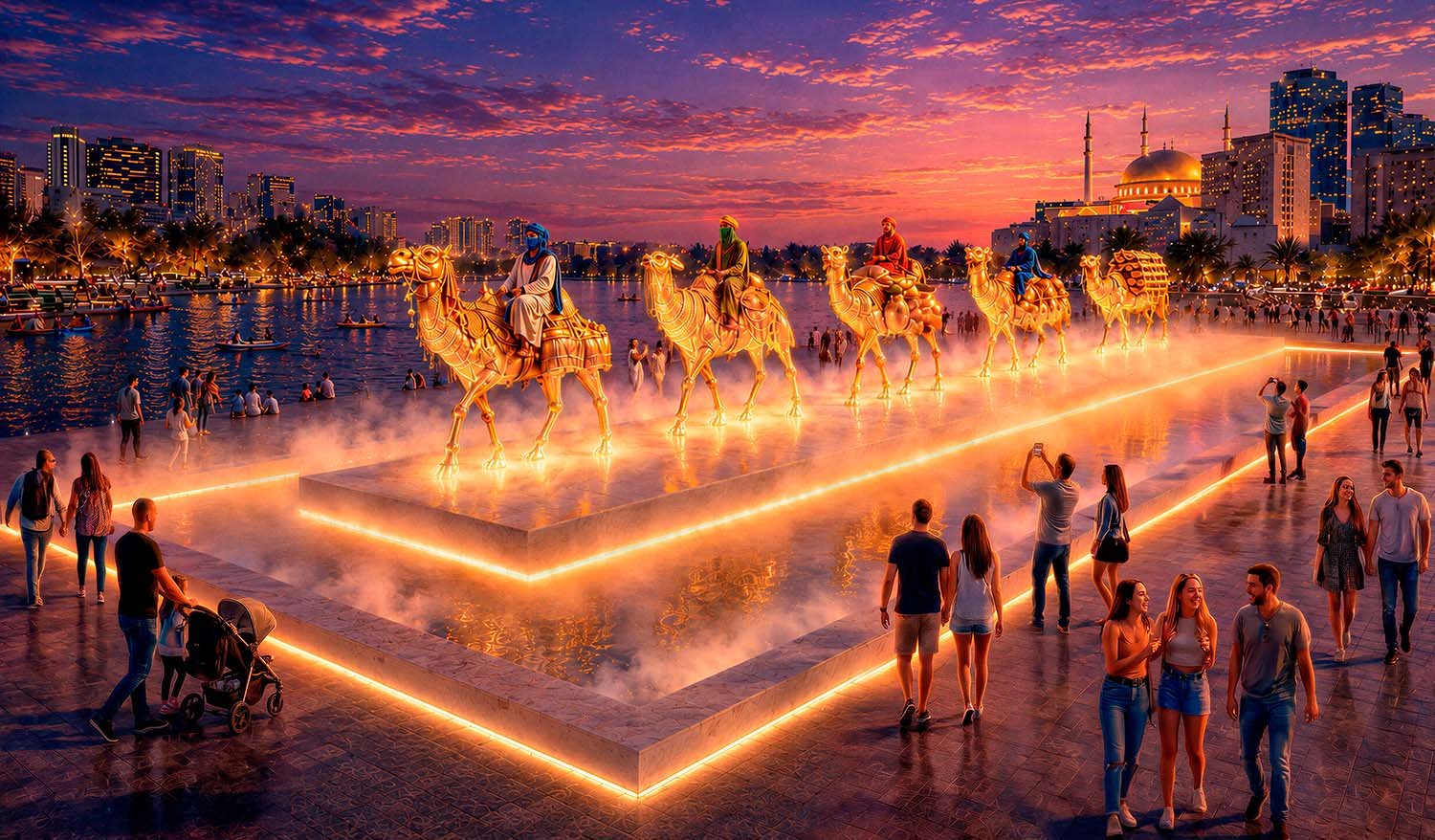
The Silk Road installation reinterprets this extraordinary legacy within a modern public setting. At the heart of the composition stands a caravan of five bronze camels moving through a landscape of water, light, mist, and reflections. More than a sculptural centerpiece, the caravan symbolizes a route that united civilizations, marketplaces, palaces, workshops, mosques, caravanserais, and entire cultures for centuries.
The project combines sculpture, water, architectural lighting, sound design, interactive technologies, and atmospheric mist. During daylight hours, it appears as a monumental sculptural composition with the presence and dignity of a museum-quality artwork. After sunset, it transforms into an immersive illuminated environment that creates a powerful visual identity and a prestigious destination within the city.
UZBEKISTAN — A HISTORIC CENTER OF THE SILK ROAD
Few countries are as closely connected to the history of the Silk Road as Uzbekistan.
It was here that caravan routes intersected with some of the world’s most influential centers of commerce, science, diplomacy, craftsmanship, architecture, and culture.
Samarkand attracted merchants, scholars, and explorers from across continents.
Bukhara became renowned as a center of knowledge, spiritual culture, and trade.
Khiva preserved the atmosphere of an ancient city where history remains embedded in architecture and urban space.
Tashkent emerged as an important crossroads connecting commercial and cultural exchange.
The Silk Road carried much more than merchandise. It transported ideas, languages, technologies, artistic traditions, and ways of thinking. For this reason, Uzbekistan can be viewed not merely as part of the Silk Road, but as one of the principal foundations upon which its history was built.
The installation celebrates this role and transforms it into a contemporary cultural symbol.
THE CARAVAN AS A SYMBOL OF MEMORY AND CONNECTION
The defining visual element of the project is a group of five bronze camel sculptures.
The caravan progresses along an elongated marble platform surrounded by water, creating a strong sense of direction, movement, and ceremonial journey.
The camels are not decorative figures. They represent endurance, dignity, exploration, trade, and cultural exchange. They recall the caravans that once crossed the territory of Uzbekistan while linking China, India, Persia, the Arab world, the Mediterranean region, and Europe.
The surrounding water enhances the perception of scale and depth. Reflections of the bronze sculptures, architectural lighting, and surrounding environment create a composition that feels monumental, refined, and timeless.
LIGHT, SOUND, WATER, AND MIST
The Silk Road functions both as a sculptural fountain and as a large-scale audiovisual experience.
A system of 110 RGB luminaires allows the installation to present a variety of lighting scenes, including warm bronze illumination, architectural accents, dynamic light waves, and carefully choreographed lighting effects across the water, marble platform, and sculptural group.
An integrated mist system introduces an additional layer of atmosphere. The drifting mist surrounding the caravan evokes images of distant horizons, desert landscapes, mirages, and ancient routes disappearing into the distance.
The installation is further enhanced by 20 concealed acoustic systems, capable of delivering immersive soundscapes. Audio content may include desert winds, distant caravan sounds, traditional Eastern musical motifs, atmospheric compositions, or specially created soundtracks for evening performances.
Together, water, light, sound, and mist create a complete sensory experience. Visitors do not simply observe a fountain; they experience the atmosphere of a journey where Uzbekistan’s rich history meets its contemporary identity.
INTERACTIVE EXPERIENCE
The installation incorporates 20 interactive modules, allowing visitors to actively participate in the experience rather than simply observe it.
Through interaction with these modules, guests can trigger a variety of lighting, sound, and atmospheric scenarios. Individual sculptures may be highlighted, waves of light can travel along the caravan route, soundscapes can recreate the feeling of a historic journey, and mist effects can introduce new visual layers to the composition.
Different scenarios may also represent various chapters of the Silk Road, transforming the installation into a storytelling environment.
This interactive system turns the fountain into a living public experience. Visitors do not merely watch the story unfold—they help activate it, shaping the atmosphere and becoming participants in a symbolic journey across centuries of history.
A CULTURAL SYMBOL OF MODERN UZBEKISTAN
The Silk Road is designed to be more than a public fountain or an urban design feature. It has the potential to become a recognizable cultural symbol.
For Uzbekistan, the concept is particularly meaningful because it draws directly from the country’s historical identity while expressing it through contemporary art, architecture, water, light, and interactive technology.
The installation demonstrates how cultural heritage can be interpreted in a modern way while preserving its significance and emotional value.
Simultaneously, the project functions as:
- a monumental fountain;
- a sculptural composition;
- an illuminated art installation;
- an interactive public attraction;
- a tourism destination;
- a photo landmark;
- a cultural symbol of place.
It creates an opportunity for residents and visitors to experience the scale of Uzbekistan’s historical legacy not through a museum display, but through an immersive public environment.
A LANDMARK FOR PUBLIC SPACE
During the day, the installation attracts attention through its scale, the richness of bronze and marble materials, the expressive sculptural composition, and the reflective surface of the surrounding water.
At night, the project reveals an entirely different character. Architectural lighting, reflections, mist effects, and immersive soundscapes transform the fountain into a dramatic focal point within the urban landscape.
The Silk Road is ideally suited to become the centerpiece of a plaza, waterfront, park, tourism district, or contemporary civic space, naturally generating visitor activity, photography, and cultural engagement.
APPLICATIONS
The Silk Road is particularly appropriate for locations seeking to establish a destination with strong cultural significance, historical depth, and a premium visual identity.
The installation can be integrated into:
- city squares and public parks;
- waterfront developments;
- museum and cultural districts;
- historic urban areas;
- hotels and resort destinations;
- tourism-oriented environments;
- exhibition grounds and event venues.
For cities, it becomes a symbol of cultural heritage and international connection.
For tourism destinations, it creates a memorable attraction and iconic photo opportunity.
For hospitality projects, it functions as a prestigious evening centerpiece.
For public spaces, it becomes a natural meeting point that attracts residents and visitors alike.
TECHNICAL SPECIFICATIONS
Dimensions
Height — 3 m
Length — 26 m
Width — 10 m
Materials
Bronze, marble
Number of sculptures
5 bronze camels
RGB lighting fixtures
110 pcs.
Interactive modules
20 pcs.
Concealed acoustic systems
20 pcs.
Power consumption
Approximately 25 kW
THE SILK ROAD — A FOUNTAIN CONNECTING PAST AND FUTURE
The Silk Road is far more than a decorative fountain. It is a cultural installation created as a contemporary artistic interpretation of Uzbekistan’s remarkable historical legacy.
By combining sculpture, water, architectural lighting, sound, mist, and interactive technology, the project creates an immersive journey that celebrates Uzbekistan’s role as one of the most influential centers of the Great Silk Road.
The installation transforms public space into a place where history is no longer observed from a distance—it becomes a living experience.
As a symbol of movement, cultural exchange, dignity, and continuity, The Silk Road has the potential to become a defining landmark that honors the past while looking confidently toward the future.